
Writing
Here are a collection of my academic writings focusing on art literature, along with a selection of my creative writing, poems, and prose.
College Research Papers
High School Magazine Publications
Prose
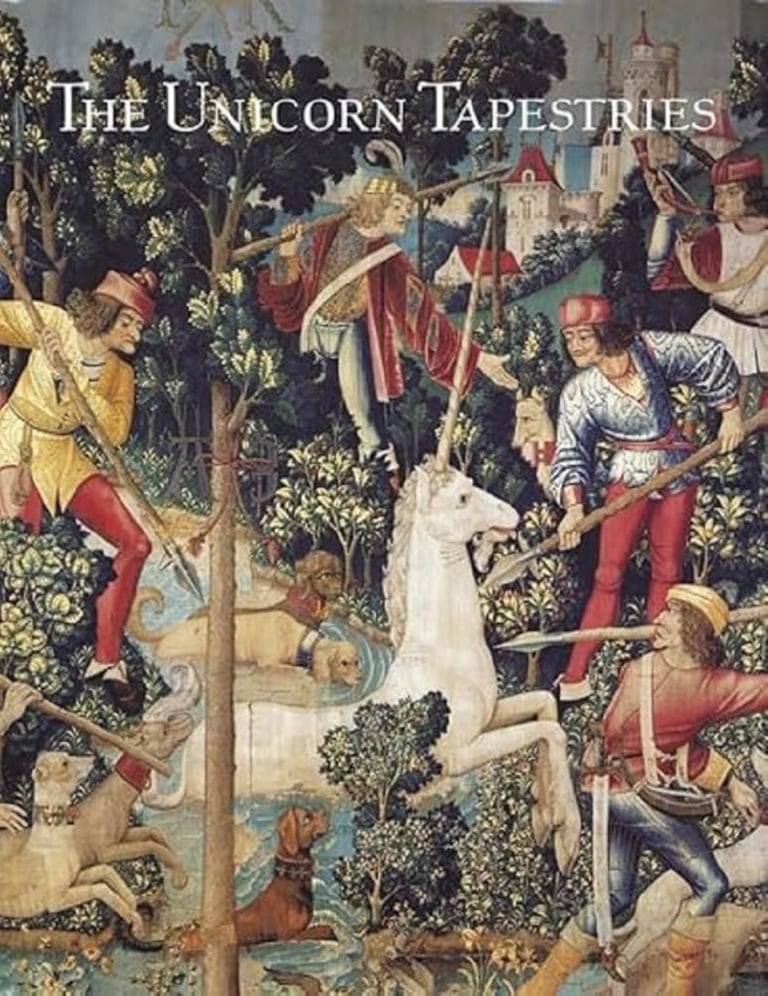
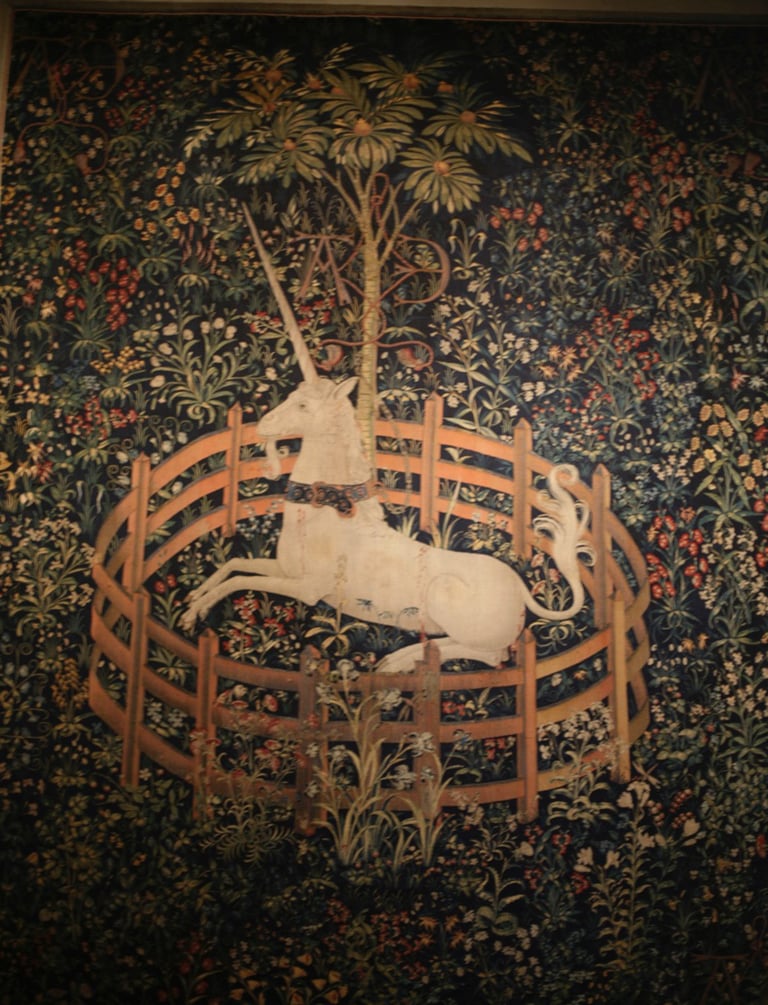
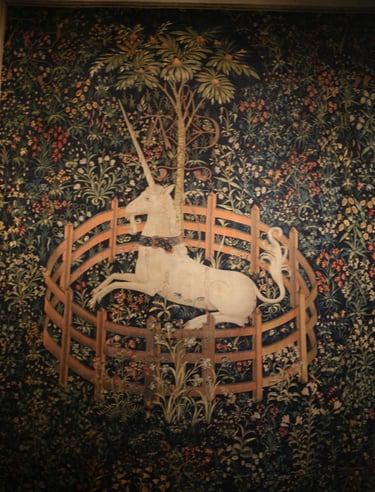
I would recommend that the acquisition committee acquire The Unicorn in Captivity c.1495-1505 tapestry (Figure 1) for the Museum of Fine Arts in Anytown, USA (MFAA). This tapestry is related to a series of tapestries (Figure 2) which were made for the European elite as the people captured in the tapestries wore outfits made in fine velvet, silks, with rich gold brocades (Zucker and Harris 2015). These tapestries were more expensive than most other art forms in medieval times (Robertson et al. 2021, 662). The unicorn tapestries are one of the most popular attractions at The Cloisters, the medieval branch of The Metropolitan Museum of Art (Cavallo 2005).
Moreover, unicorns, during medieval times, were not simply mythical creatures spotlit in children’s fantasy stories; it was an extremely popular symbol, later becoming allegories of truth and religion, which is reflected in The Unicorn in Captivity. Hence, The Unicorn in Captivity is not just another piece of art but is an artwork that testifies unicorn’s important role as the mythical mare in medieval tales. With this richer allegory story, unicorns’ intricate beauty increased The Unicorn in Captivity’s aesthetic value in acquisition.
The Unicorn in Captivity is made of exquisite and expensive materials, such as wool imported from Italy and Spain, shimmering silk, metallic threads of gold and silver (Zucker and Harris 2015). It is 12 ft. 1 in. long and 8 ft. 3 in. wide (3.68 × 2.52 m) (Robertson et al. 2021, 662). The number and quantity of valuable materials used on this huge piece of artwork no doubt increase the acquisition value of one of these exquisite and enigmatic tapestries.
According to Zucker and Harris (2015), the tapestry was made with the wrap and weft technique. This technique is anything but easy and simple. It required looms that were custom-built to the height of each tapestry; for this one, it was 8 ft. 3 in (3.68m), which demanded a huge amount of imported wool carded to comb the fibers together, and then tightly spun to weave between twelve to twenty rows of thread per inch (Zucker and Harris 2015, 662).
The benefit of this phenomenon peculiar tapestry-weaving technique, is to make sure the details shown at the back of the tapestry copy the front, just in reverse, with accuracy to the strand of hair. This is because the weft threads of each color are woven only over the exact area where the design requires them, and the loose ends are hidden because they are thin and tightly wrapped around the warp threads (Freeman 1973, 221).
The Unicorn in Captivity’s origins are as mysterious as its beauty. First, the artist of the tapestry is unknown (Zucker and Harris 2015). There might be more than one designer (Freeman 1973, 220). Robertson et al. (2021, 662) even suggest that these tapestries could be woven by dozens of weavers under the supervision of a master. However, most people think it was woven in Flanders, Brussels, where famous silk and wool industries were located (Robertson et al. 2021, 662).
Second, although The Unicorn in Captivity is mostly recognized as in the same series as the other six tapestries, all woven by the same artist(s), the order of the tapestries and the connection of The Unicorn in Captivity with the other tapestries are debatable. Most historians believe The Unicorn in Captivity is the last of the seven-tapestries series after the hunting theme (Robertson et al. 2021, 662). The first six tapestries tell the story of hunting the mythical mare, as explained by Robertson et al. (2021), “This series tells the story of a hunt in which hunters, noblemen, dogs, a stag, and a lion chase a unicorn through the forest.” This leads to the question whether The Unicorn in Captivity is the concluding tapestry (Freeman 1973) or a stand-alone tapestry because of its vertical orientation, and more importantly, its theme shifts from hunting to nature (Zucker and Harris 2015).
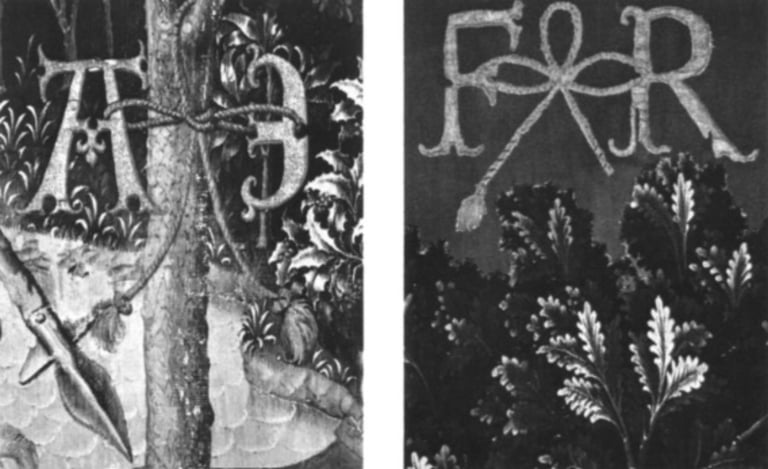
Finally, the commissioner of the unicorn tapestries is also a mystery (Zucker and Harris 2015, Freeman 1973). Freeman (1973) states that these tapestries were adorned in François VI de La Rochefoucauld's (a nobleman and writer) bedroom and later even used to cover up vegetables in a peasant’s house. There is also a possible connection between the La Rochefoucauld house and the AE (Figure 3), the first and last characters in FranSois’s son’s name, Antoine (Freeman 1973, 225). Yet, this mystery didn’t affect its popularity (Zucker and Harris 2015). Indeed, these originality debates have added scholarly value to acquire Unicorn in Captivity as more researchers will be drawn to observe this tapestry in person to form their own opinions.
The demonstration of unicorn allegories adds a further layer of aesthetics, making acquiring The Unicorn in Captivity even more valuable. Nowadays, unicorns are mostly regarded as childhood aspirations or merely a myth, but unicorns were very popular in medieval Greece and Rome (Zucker and Harris 2015). By the 15th century, Europeans were fascinated by the exotic animals in other countries, most commonly in Asia. This spark of curiosity made unicorns even more popular with an added historical myth. Soon, tales of unicorns, which originated from the medieval bestiaries, granted unicorns magical powers such as healing (Zucker and Harris 2015).
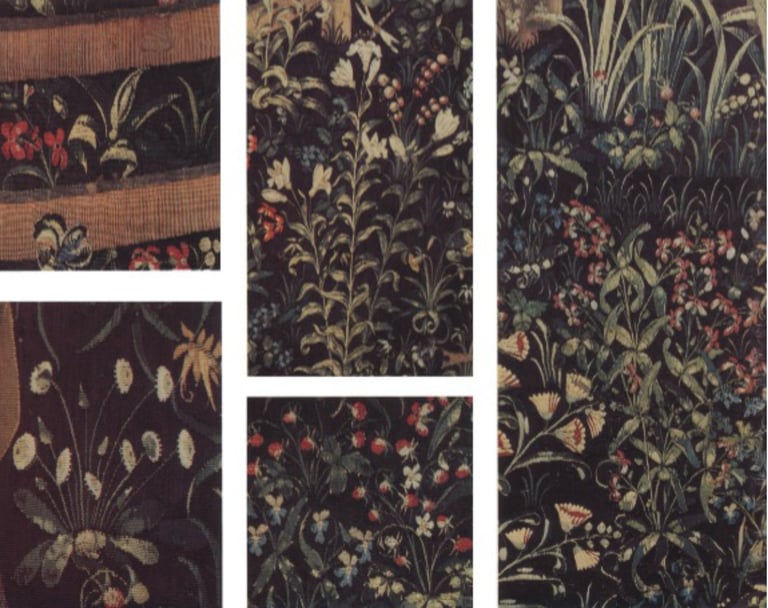
Since unicorns were described as super difficult to hunt, it was no surprise that the artist(s) of the tapestries boasted the capturing of unicorns, which was the sole focal point in The Unicorn in Captivity. The power and rarity of a unicorn in captivity illustrated the climax of the hunting themes of this series of tapestries (Zucker and Harris 2015), making The Unicorn in Captivity more valuable and desirable to acquire than the rest. Moreover, Freeman (1973, 214) argues that “The Unicorn in Captivity could be the most beautiful of all the series due to its exquisite spread of flowers (Figure 4), envisioning the sights and smells of spring and early summer amidst the dreadful winter. This tapestry, filled with botanical symbolism, signifies earthly love and fruitful marriage more than the others.”
The unicorn allegories did not end here. As unicorns’ tales said that unicorns could only be caught by a maiden, that is, by a virgin. This story further developed religious meaning: the unicorn was associated with Christ, and the maiden who attracted it was associated with the Virgin Mary (Zucker and Harris 2015). Among all the series of tapestries, The Unicorn in Captivity was referred to the most to illustrate this allegory. “Here the unicorn may be interpreted as the risen Christ in the midst of the Paradise garden...he is collared and chained to a tree...[so] he is also an image of the lover-bridegroom, at last secured by his adored lady, his bride” (Freeman 1973, 214). Analysts portrayed this tapestry either as a marriage or a Christian allegory, depicted by poets such as Dan Atherton (Atherton 1952).
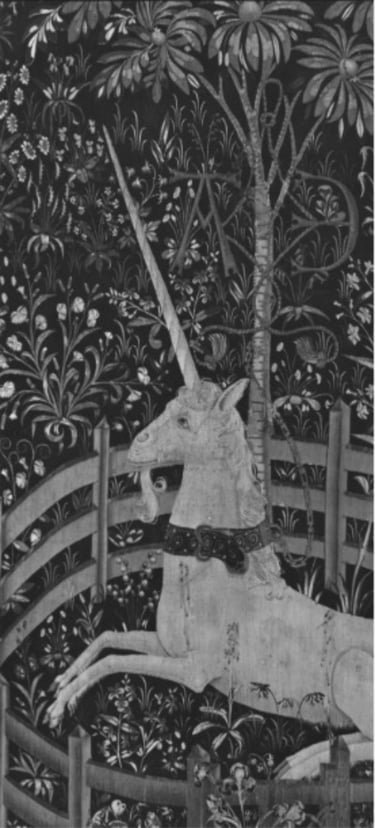
The collar or chaîne d'amour (love chain) (Figure 5) in medieval poetry symbolizes the gentleman's devotion to his lady and his complete subjection to her will (Freeman 1973, 216). The fence around the unicorn shows the entrapment of the unicorn (Robertson et al. 2021, 662). However, the unicorn is content and doesn’t attempt to escape. This illustrates a husband’s devotion to his wife and marriage (Freeman 1973). The pomegranate’s juice could be a symbol of fertility (Freeman, 1973). The unicorn is placed below the pomegranate tree to symbolize matrimony and Christ’s sacrifice in Christian allegory (Robertson et al. 2021, 662). The mille-fluers (a thousand flowers) around the unicorn also have symbolisms of fertility (Robertson et al. 2021, 662). The carnation flowers, specifically, have become a huge symbol of marriage and Christ. They can also "symbolize the nails driven into Christ's hands and feet because of the similarity of its fragrance to the nail-shaped clove" (Freeman 1973).
The Unicorn of Captivity truly is a great addition to any museum. Besides its beauty, it challenges the perception that unicorns only exist in fairy tales. As the tapestry unveils, its mythical interpretation allows both young and old to tap into their child-self to rediscover the magical mares' impact on history via symbolism. The Unicorn in Captivity illustrates how foreign animals have sparked curiosity and put a stamp on the course of history. It also has a very practical function of covering cold walls in winter (Robertson et al. 2021, 662).
In conclusion,The Unicorn of Captivityis a great acquisition. This masterfully woven tapestry from the 15th century will attract children for its imaginary fantasy, adults for its naturalistically depicted scenes of flora and fauna of the landscape, artists for its unique woven technique, scholars for its mysterious origins, collectors for its unmatched value and rarity, and historians for its thought-provoking symbolism. Above all, everyone will be amazed by its pure beauty and splendor while pondering on its meaning.The Unicorn of Captivityis a dream to acquire for MFAA.
The Unicorn of Captivity
November 12th, 2025
Works Cited
Atherton, Dan. 1952. “Unicorn in Captivity.” Chicago Review 6 (3): 13–13.
https://doi.org/10.2307/25292926.
Cavallo, Adolfo S. 2005. The Unicorn Tapestries in The Metropolitan Museum of Art.
Metropolitan Museum of Art Publications.
Freeman, Margaret B. 1973. “The Unicorn Tapestries.” The Metropolitan Museum of Art Bulletin
32 (1): 177–224. Adapted by Linda Sipress. https://doi.org/10.2307/3258590.
Robertson, Jean, et al. 2021. The History of Art: A Global View - Prehistory to the Present. 1st ed.
Thames & Hudson Inc.
Zucker, Steven, and Beth Harris. 2015. "The Unicorn Tapestries." Smarthistory, November 29.
Accessed November 3, 2025. https://smarthistory.org/the-unicorn-in-captivity/.
Figure 1: The Unicorn in Captivity, 1495-1505
Source: Cloisters Museum, Metropolitan Museum of Art, New York (from the Hunt of the Unicorn tapestry series) (Robertson et al. 2021, 662).
Figure 2: The Unicorn Tapestries in The Metropolitan Museum of Art
Source: Cover from Cavallo (2005)
Figure 3: The AE Abbreviation
Source: (Freeman 1973, 225)
Figure 4: Flowers on the Unicorn in Captivity
Figure 5: The Chaîne d' Amour (Love Chain)
Source: (Freeman 1973, 218)
Source: (Freeman 1973, 216)
The ancient Paleolithic (24,000–22,000 BCE) and Cyclidian (2600–2300 BCE) cultures cherished fertility as the utmost quest for womanhood.
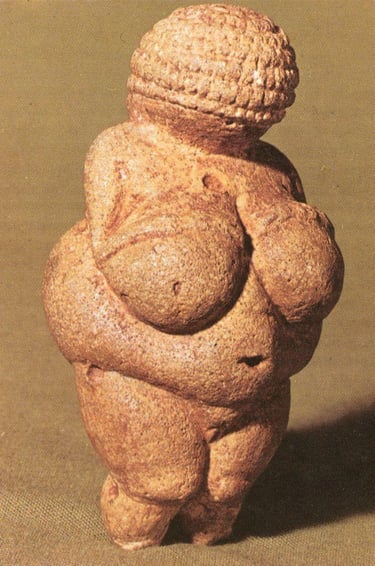
During the Paleolithic period, humans lived as wanderers and hunter-gatherers so they must constantly move from one place to another in search of food. Hence, most artworks during that time were lost because they were paintings on cave walls and thus weren’t portable (Wilson; Zygmont). Yet, the Woman of Willandorf (fig. 1), a 4- and 3/8-inches long statue, has been preserved till today and became one of the most famous Paleolithic artworks (Zygmont). This statue must have been significant enough for its owners to carry around during the nomadic wanderings.
This handheld limestone sculpture exaggerated the woman’s reproductive organs by distorting her anatomy. Since there were no written records, Paleolithic art recorded the history. Robertson et al. explained that artists used forms to emphasize points of significance in an artwork. In this statue, “The most conspicuous elements of her anatomy are those that deal with the process of reproduction and child rearing” (Zygmont). As shown in Figure 1, the breasts, the crotch, and the size of her stomach were all enlarged, while the arms resting on the breasts were made much smaller. The pubic region was emphasized by red ochre (Wilson; Zygmont), while her head was down and her face was covered by a mask or braids of hair. Since fat was beautiful in the Stone Age, this statue symbolized health and abundance. Yet, the woman was given no sight, speech, or reach - no identity as an individual (Paglia). Thus, fertility was the most important element in women’s beauty/value and women were treated no more than childbearing engines (Paglia; Zygmont).
As mentioned before, Dr. Wilson explained humans were wanderers, constantly moving due to limited resources; it was essential for a woman to bear lots of children for hunting and planting. This explained why The Woman of Willandorf was carried around to bless every woman’s fertility.
The Cyclidians dated after the Paleolithics also relied on arts to record history. However, they had looting which destroyed many artworks and made it even more difficult to know their culture (Zygmont). However, this looting did not destroy the Figurine of a Woman because there was a surplus amount of them. The fact that many of these figurines have survived till today demonstrates the common norm or culture reflected in this type of marble statues (Bulger).
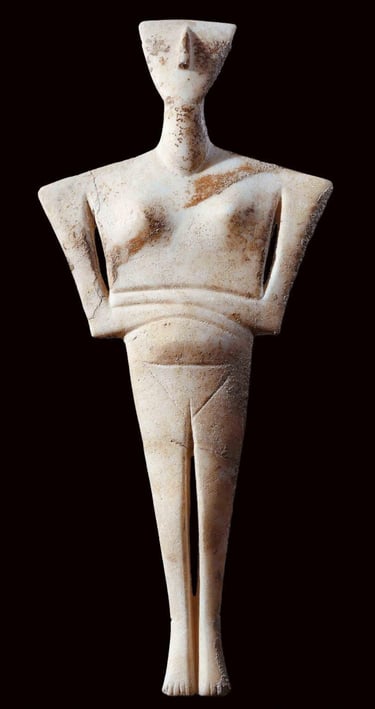
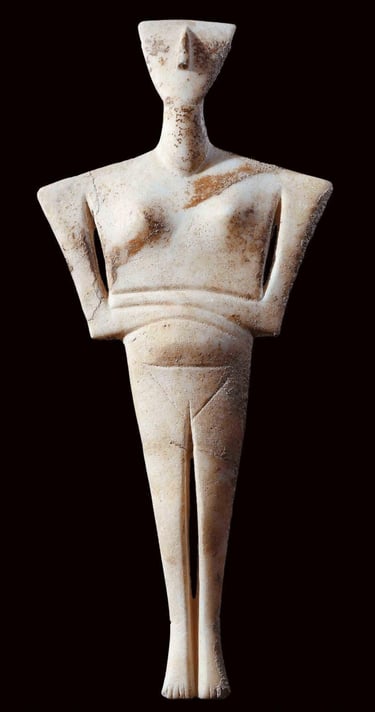
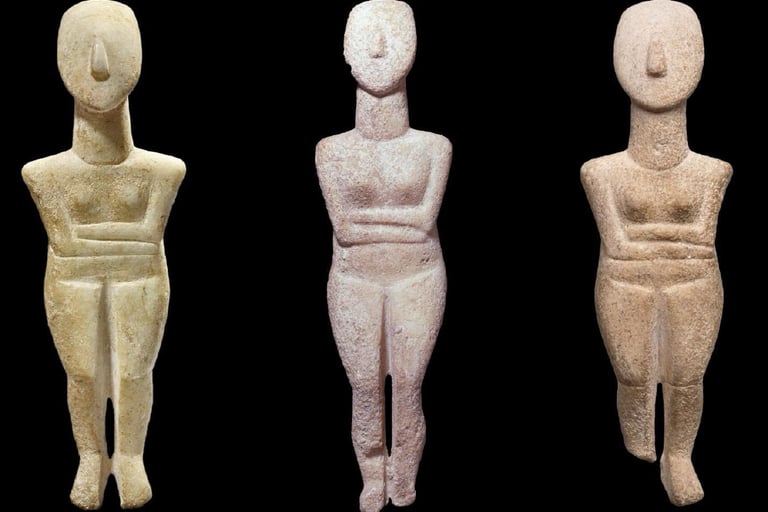
Unlike the Woman of Willandorf, the Figurine of a Woman was carved from marble (Paglia) and these figurines could be much larger, ranging from tiny 6.2 centimeters to 1.53-meter-tall (2.44 - 60.24 inches) (MacGillivray). Also, as shown in Figure 2, the forms were not as round; they had more geometric shapes. The female body was elongated and geometric. The sex organs are treated schematically - a pubic delta. Although both statues are almost symmetric, an interesting difference is that, compared to the Woman of Willandorf, the breasts in the Figurine of a Woman are much smaller (Bulger). In fact, her breasts are so small that her arms go under her breasts instead of over her breasts. However, Bulger noted that the Figurine of a Woman does have an “incised pubic triangle.” Hence, both sculptures emphasized women’s reproductive areas.
This emphasis can be seen on almost all the figurines produced at that time (see fig. 3) so it’s no surprise that the Figurine of a Woman reflected again the society’s huge emphasis on fertility. There is also a debate that the Figurine of a Woman is composed of many stages of a woman’s reproductive life. “A person might acquire a figure early in her life, painting its face with the markings she herself wore to her wedding when she got married, and later re-painting it with the patterns she wore during the dangerous time of childbirth. Finally, when a person died, her figure might be repainted once more to depict a state of mourning” (Bulger). This is because they were often found in graves. This more debatable view could be why, for the first time, women had faces (Bulger)! The Figurine of a Woman has a nose and there are even traces of paint used to draw the eyes (figs. 2 and 3)!
Starting from the Cyclidians era, humans began to settle down (Wilson). This could be another explanation of the smallness of the breasts. Fertility could still be the focus but other activities such as rituals came to play a role. There is evidence that the marble figurines were used in rituals (Bulger) and hence the purpose was not purely emphasizing fertility. Yet, although the head or limbs can’t be defined in some figurines, they still have an incised pubic triangle, marking it as a woman (Bulger). Thus, one can’t diminish the fact that fertility was still the focus whether it was emphasized by oversized breasts or the more subtle focal point on the pubic area. They are all women’s reproductive organs.
Looking at these two periods, even though they’re from different time periods, different materials, with different livelihoods, it seems fertility is valued in both periods, just in different ways. The question is, will fertility continue to be the universal quest for women through the different livelihoods of our age? As women began to express themselves more through dream jobs or fertility health, what would be the signature womanhood characteristic(s) worth pursuing, that makes woman a woman?
Works Cited
Bulger, Monica. "Early Cycladic Figurines." SmartHistory - The Center for Public Art History,
22 March 2024, https://smarthistory.org/early-cycladic-figurines/. Accessed 13 September 2025.
MacGillivray, Joseph A. “Who Were the Early Cycladic Figures? Discover the fascinating
history behind these enigmatic objects.” The MET, 24 January 2024, https://www.metmuseum.org/perspectives/cycladic-figures. Accessed 13 September 2025.
Paglia, Camille. "The Cruel Mirror: Body Type and Body Image as Reflected in Art."
Art Documentation: Journal of the Art Libraries Society of North America, vol. 23, no. 2, Fall 2004, pp. 4-7. JSTOR, http://www.jstor.org/stable/27949310.
Robertson, Jean, et al. The History of Art: A Global View - Prehistory to the Present. 1st ed.,
Thames & Hudson Inc, 2021.
Wilson, Christopher. "ARTH 111 Lecture Notes." Ringling College of Art and Design, Sarasota,
30 August 2025.
Zygmont, Dr. Bryan. "Venus of Willendorf."SmartHistory - The Center for Public Art History,
21 November 2015,https://smarthistory.org/venus-of-willendorf/. Accessed 9 September 2025.
The Make of Divine Womanhood: Paleolithic vs Cycladic Era
September 16th, 2025
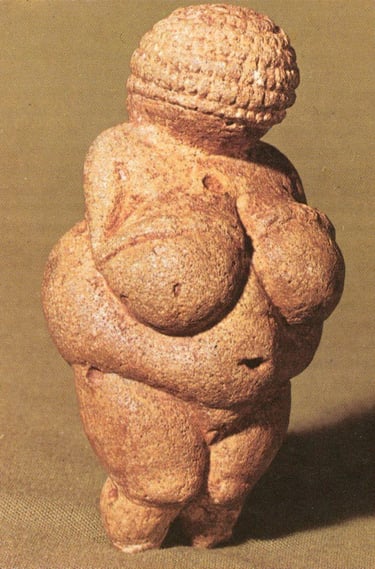
Figure 1: Woman of Willandorf
Source: Statuette (Oôlitic Limestone; Ht. 4 1/8"; Traces of Pink Color).Sculpture. Vienna: Mus., Naturhistorisches.; Found during excavations at the station of Willendorf, (lower Austria, Danube Valley), by Hugo Obermaier, 1908,JSTOR,https://www.jstor.org/stable/community.11650893.Accessed 12 Sept. 2025
Figure 2: Figurine of a Woman
Source: Found in a grave on Syros, Greece, Early Cycladic, c. 2600–2300 BCE. Marble, 18 in. Tall. National Archaeological Museum, Athens (Robertson 164).
Figure 3: Figurines of a Woman
Source: Left: The Bent Sculptor, Early Cycladic figurine, 2700–2500 B.C.E., marble, 17.1 x 5.7 x 2.9 cm (Musée du Louvre, Paris); center: The Bent Sculptor, Early Cycladic Figurine, 2700–2500 B.C.E., marble, 14.9 cm high (© The Trustees of the British Museum, London); right: The Bent Sculptor, Early Cycladic Figurine, 2700–2500 B.C.E., marble, 18 x 5.5 x 8.5 cm (Harvard Art Museums/Arthur M. Sackler Museum, Cambridge) (Bulger)
In the movie Can You Ever Forgive Me, Lee Israel is the protagonist. We meet her in a close-up shot at 3am working on a manuscript. From the very first few minutes, we know she is the center of our story. The shots focused on her by mainly shooting her in the foreground while putting others including her boss in the background.
As coworkers scold her for drinking on the job, in frustration, she rubs her nose and cusses everyone out - including her supervisor. Her impatient personality backfires, resulting in her getting fired. The following scenes make it very clear that the film will go through her struggles of losing her job, being broke, feeling sorry for her sick cat, etc. to clearly set her up as the star of the show. We also know this by going through her day-to-day routine, getting intimate with her.
What’s interesting about Lee Israel is that she doesn’t follow the AIM formula at all! First, she isn’t what we would call “attractive.” She is middle aged and has almost no association with any of the princesses like characters. She is not a beautiful damsel in distress waiting to be saved. She has shortish messy hair, her clothes are tattered in grey showing her poor financial standing (not the prettiest), and she rarely smiles but often in anger. Her living space shows more so as we find out that even the exterminator for the flies refused to go inside because her place smells so bad!
Lee also fails to be a moral character. She is quite a hypocrite and has very low moral standards for herself. She gets mad at Tom Clancy for his excessive drinking problem and “fraudship”, ignoring the fact she has drinking problems too and later becomes a fraud herself. We see from the beginning that she drinks a lot, in fact, the movie has lots of scenes at bars. She later gets into forgery and even stealing to make ends meet. She does this by taking letters from prolific writers in the past and “embellishing” them. When people catch her writings fake, she steals an authentic original letter and replaces it with her counterfeit! She then asks Jack to sell the original and split the gain.
Although Lee is missing two out of the three AIM elements, she is insightful. She becomes a massive expert in mimicking the writing style of prolific writers. She also makes up a believable story portraying “her cousin” as a collector. Later, she steals an original authentic letter without getting caught!
Lee does not start as a hero. Readers no longer want to buy her books. She is so unpopular, her books are 75 percent off. Although she steals someone’s coat right at the beginning, she is still quite honest about her own writings. She also has a dream to be a great writer and write her own novels. Yet, as she can’t pay her bills, she loses her confidence and things start to go downhill after she accidentally finds a new way to earn money, from writing and selling counterfeits.
At first, Lee is just using her own typewriter, and then she gets various kinds of ancient typewriters to produce fake letters. At one point, we see a whole montage of her typing away these letters. Another time, she takes papers out of the oven after baking them to create an ancient look. She first sells her letters by herself and then she asks Jack to sell them for her when nobody will buy from her. (After realizing he does a pretty good job too) Eventually, after getting caught, she starts stealing authentic letters, so her crime escalates in her desperation.
Lee Israel turns to a hero only toward the end of the story. It is until the very end of the film that Lee finally realizes the vicious circle of her poor decisions and attitudes leading to her self-destruction. She finally wants to make everything right and starts writing her own story. She also makes peace with Jack and gets approval from him for including his part of the story in her coming book. It is till the very end of the film that she becomes a hero who has overcome all difficulties to achieve her dream of becoming a good writer again.
Lee Israel is a great protagonist because her struggles are somehow relatable to many of us. The whole film is mainly focused on her fear of being judged and constantly rejected, which pushes her to do one wrong after another. Lee appears to be a tough person. She has very little patience and consideration for others so even her very own agent has turned against her. Her agent told her if she wants to get anywhere, she needs to learn to be a kind person. Moreover, Lee gets angry when things don’t go in her favor. Her toxic behavior has closed a lot of opportunities.
Her challenge to be financially stable, her desire to be influential, her reality of being a jerk and her temptation to take a shortcut, all these can be experienced by any of us at any time. This makes her more down to earth than a cute and obedient princess. Hence, it is so much more encouraging when she finally succeeds and is recognized by her own writing. We find this out in the end credits like an epilogue. She sets an example for all as a conqueror of all misfortunes.
A non-hero heroic protagonist is a good choice for this narrative because most of us are not perfect and may face the same issues that Lee faces. If Lee is perfect, poised, and wealthy, we probably would not have related to her. Let alone, the suspense wouldn’t drag on. Lee’s comeback as a hero makes a more significant impact on viewers and makes more people feel more confident to overcome their difficulties.
The viewers can take away a few lessons from Lee’s character. One is not to worry what others think of you - whatever you have inside you, express that out. One’s own story can be as good as that of a famous person. The other is that deceiving others won’t lead to good outcomes regardless of the circumstances. The truth will be revealed, and it won’t be a pretty day. Third is to have wisdom in choosing friends. Lee doesn’t have to befriend Jack. Even though he is helpful, such as cleaning the house before for the fly exterminator to come back, and more importantly, to be there for Lee when others deserted her, he isn't the best sidekick. He encourages Lee to drink more, party, and fails to take care of her cat when she is away. I believe this story also reveals the cruelty that people may be forced to do what they hate if they are too poor to survive. Lee gets to the point where she is willing to do anything to make ends meet.
In sum, the movie, Can You Ever Forgive Me? is inspired by a true story of Lee Israel. This film surprisingly doesn’t follow the AIM formula. Instead of characterizing the protagonist, Lee, as a graceful “princess” and a lady of honor, Lee is an ordinary middle-aged woman who slyly paid off her bills with forgeries. Although she has many characteristic issues as well as financial issues, we learn later that she did pull it off and make a victorious comeback. This tells us that it is never too late to do the right thing, and we can do it if we believe in ourselves.
Character Analysis for "Can You Ever Forgive Me"
April 23rd, 2025
Abstraction Inspired by Post-Impressionism
May 26th, 2024
For an artist, technique is the base of every craft while color is a doorway to the soul. Could one art style inspire another emerged at a different period in terms of the use of technique and color?
Soon to call Los Angeles home, Siyuan Chen is super excited for a new chapter in his artistic journey. When asked about his art style, he reflected, “Every good artist is good because each shows unique characteristics that differ from all the others! Innovation is a must, but innovation is not behind closed doors, but is to follow one’s inner emotions and thoughts; and is the result of rational thinking, absorbing from others, and continuous trying! This is how I have treated my artistic innovation and strived to develop my own unique style in my paintings!”
When asked about his artistic heroes, he said he was always fascinated by how art evolved over time. He was surprisingly very fond of post-impressionism, “Cezanne, Van Gogh and Gauguin, the three masters of post-impressionism, have a great influence on me.” This may sound ironic because Chen’s artwork is not representational but abstract. He explained further, “Cezanne influences me on his capture of space, Van Gogh on passion, and Gauguin on symbolism.”
It may be hard for one to realize how post-impressionism may give inspiration to abstraction as most post-impressionist paintings are representational. However, for Siyuan Chen, the inspiration didn’t lie within the subject matters. It was all about the techniques and color: swirls of paint turn into lush trees, smudges of oil become clouds, and sweeps of a brush turn paint into oceans.
(Jones, Section 33) explains the processes of Post-Impressionism, “[They] extended the use of vivid colors, thick application of paint, distinctive brush strokes, and real-life subject matter, and were more inclined to emphasize geometric forms, distort forms for expressive effect, and to use unnatural or arbitrary colors in their compositions.” In sum, Post-Impressionists were more emotional driven, using techniques to their full advantage.
(Samu, 2024) elaborated the second key element for Post-Impressionism, “In addition to their radical technique, the bright colors of Impressionist canvases were shocking for eyes accustomed to the more sober colors of academic painting.” Vivid and bright colors took the spotlight for the first time.
Siyuan Chen incorporates these two principles into his artwork immensely. “My paintings use representational conceptual brushwork and image-like gorgeous colors to create the imprint of certain things or objects to reflect the inexplicable state of complex yet free wellbeing (Chen).” This is clearly reflected in his two pieces I chose to compare: “Light at the Narrow Gate” and “Blessing 15.” At first glance, the bright colors in both pieces seem to call out to the viewer. Upon further inspection, brushstrokes begin to appear - and a show begins: color combinations sing in harmony as the brushstrokes appear to be dancing on the canvas.
Moreover, “[I use] freehand brushwork, like the cursive style of Chinese calligraphy. In terms of color, I like to use complimentary colors to achieve harmony after collision of colors. In terms of composition, I usually leave an empty space on my paintings, as an entrance to the deeper universe or imaginary world. The forms of the abstract image are bionic, like everything in nature, one sees what one wants to see, depending on the viewer's mood. In the process of painting, I will wipe, render, overlay, and more often, as I paint, I encounter a dialogue with my own emotions, which is both historical and current (Chen)!”
This dialogue is probably the foundation for the differences. Life of the Narrow Gate is a triptych; each has its unique color scheme. From left to right: It starts off with a main composition of green and then a blue color palette and finishes off with a yellow composition. This triptych is composed to show the journey of life.
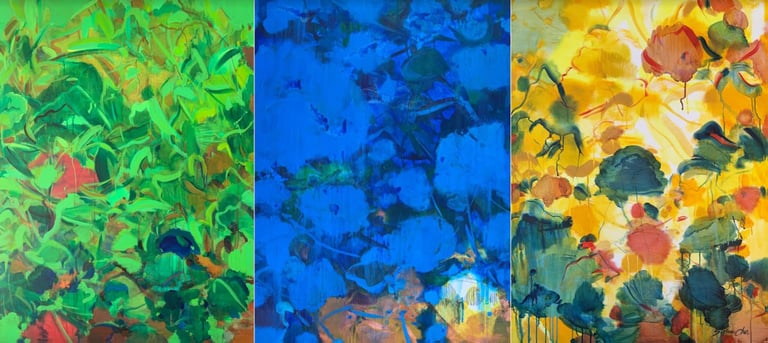
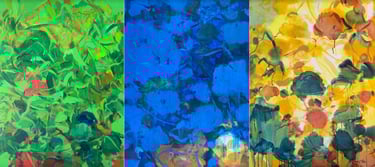
The first thing one notices is that the bright colors jump out. Both (Jones) and (Samu) have noticed the importance of bright vivid colors in post-impressionistic art. Although each painting is so different from each other, the three still echo one another in their color themes. Each painting has a bit of yellow ochre and greenish hues to echo each other. Upon further inspection though, one will notice that there is more than what meets the eye.
Aside from the neon-light inspired green in the far-left green piece, there is vivid movement through rhythmic brushstrokes dancing on the canvas, which pays homage to the post-impressionism techniques. If one looks closer, one may imagine a possible inspiration from Vincent Van Gogh through the thick layering of paint like impasto. “One of Van Gogh's works that had a great influence on me is his ‘Starry Sky.’ The brushwork, the color, and the image are all so free, passionate and vivid!” as Siyuan Chen reflecting on the masters’ works that had left a lasting impression on him.(Jones)explains Gogh’s style as “[He] used vibrant colors and active brush strokes to convey his feelings in the face of nature and his state of mind.” Great minds think alike!
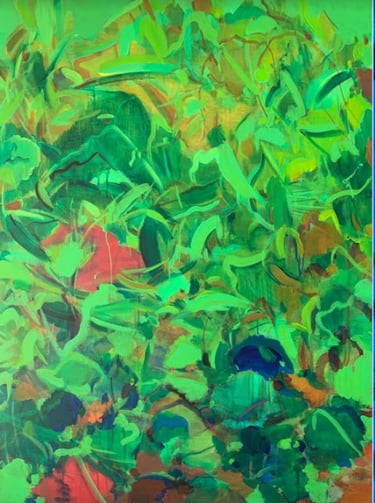
The different tones of green could hint at different stages of life and how one gets better and brighter as time passes by. The green also shows Chen’s style in capturing depth. Unlike the bright green, glowing red, and deep blue, the yellow ochre in the background is muted, allowing the other colors to jump forward. This technique used to create depth is also present in the other two pieces in this triptych, and “Blessing 15.”
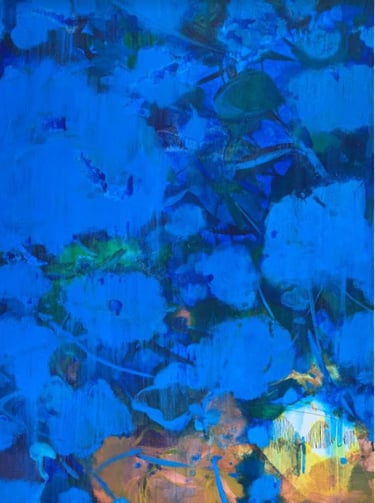
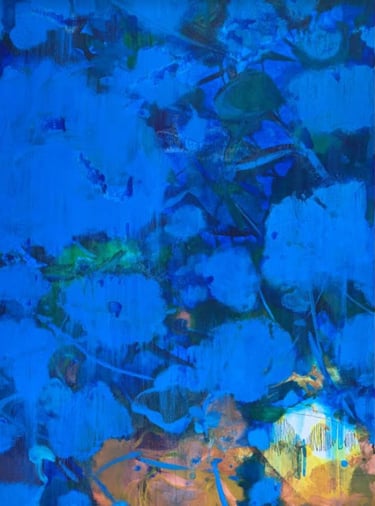
The middle piece is mostly dominated by blue. In Chen’s words, he explained this piece to “capture quietness, like the night sky or the deep ocean, which breeds new reverie in meditation. It contrasts with the yellow tone, forming a complementary time and space.” This piece is arguably the moodiest piece in the triptych. The multitude of blues becomes an ocean of discovery as different blues jump into viewer’s eyes. However, this piece is not completely monochromatic. Not only are there different tones and different shades of blue but also subtle hints of green, like hidden seaweed added to the mystery and moodiness. The pale seafoam like blue on the top seems to be “wiped” to create this effect, again echoing post-impressionism techniques. These heavy analogous color schemes create depth and bring eerie quietness to the mix. This silence is broken through a mixture of yellow ochre and orange on the bottom looking like speckled fish in the deep sea to bring life. This provides a transition into the final piece of this triptych.
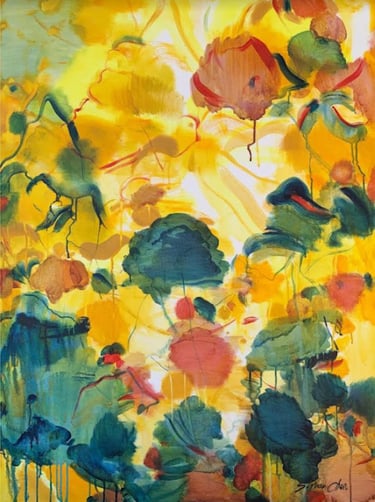
The final piece is a display of yellow. Aside from the dominant yellow, it is filled with life elements in imitations of impasto, dry brushing, and mixed on the spot, morphed into familiar forms such as flowers, birds, bushes, mountains, and even possible human faces. This piece also has the most variation in color with the additions of reds, oranges, and green. The colors radiate, injecting energy throughout the piece. This makes this triptych end on a happy note, showing that through the trials of life, it’s all going to be worth it.
In comparison, Blessing 15 is a singular piece, and at first glance, looks monochromatic, too. The whole painting is encased and growing in a forest of mint green. This unique green is strangely satisfying, and its sobered tone allows the life elements including the forest. However, this forest is budding and blooming with life and other bright colors. One may find many different narratives and observations, encouraging audience participation. To name a few examples, one may see a baby bear with its mother hiding near a tulip on the left side, and a hibiscus flower on the right. On the bottom, one may see a dragon taking a bath in a lake.
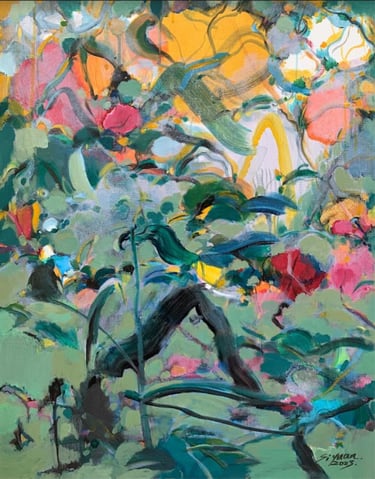
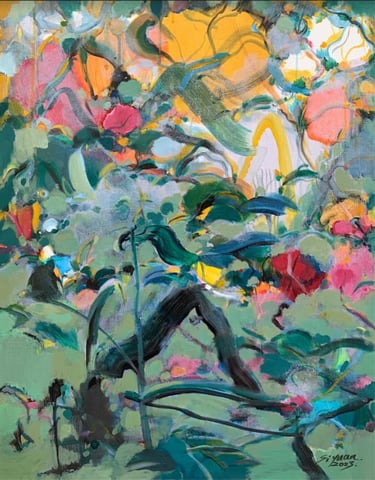
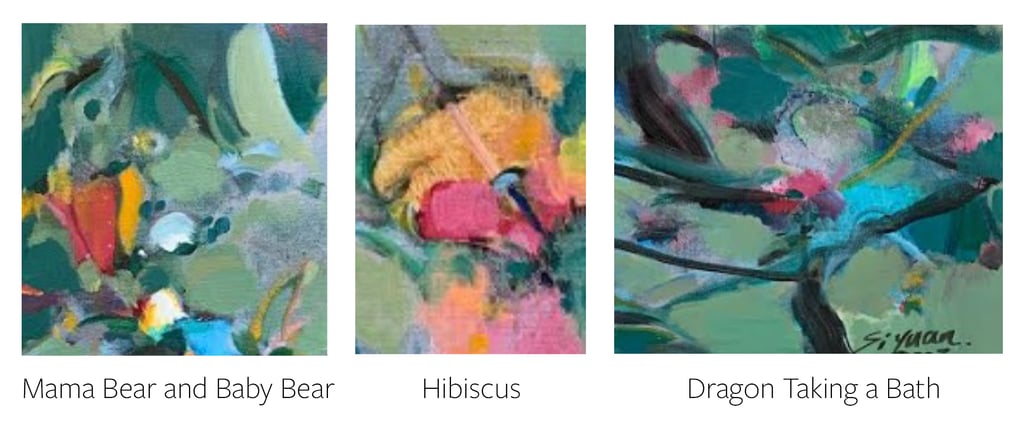
Both artworks capture the beauty of post-impressionism through the usage of dancing brushstrokes and intense colors. Each piece uses techniques such as dry brushing, splotches, and imitations of impasto to bring visual interest and rhythm. In terms of color, both artworks have reds, yellows, greens, and blues. Yet, each has a main color scheme to unify the piece with accents of different colors and hints of symbolism.
There are subtle differences between the pieces, too. Considering “Light at the Narrow Gate,” the blue piece has lines made with a marker while “Blessing 15” has lines made with water-downed paint.
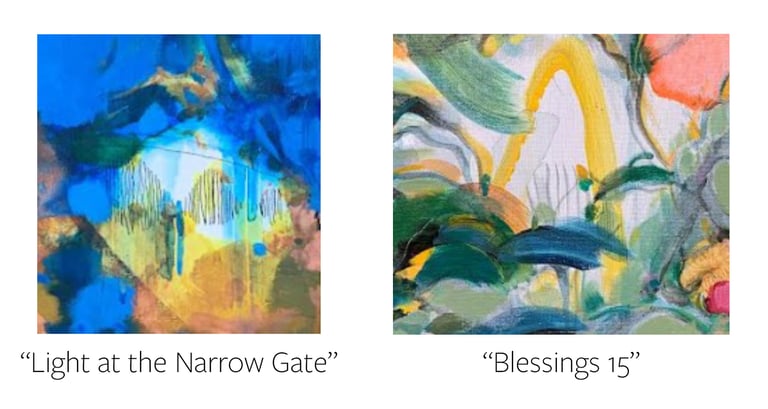
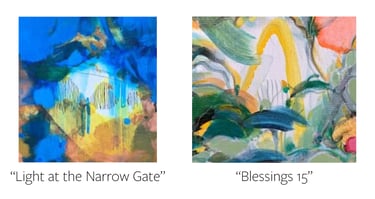
There are also different color schemes. “Light of the Narrow Gate” is more color-theory driven through the usage of split-complementary and analogous color relationships versus “Blessing 15” uses complimentary as a start but then the rules are broken by adding other unique colors.
Depth is also created differently. “Light of the Narrow Gate” mainly relied on subdued colors in the back while having lighter colors pop in the front. In “Blessing 15,” the forest is mainly of a light mint green, and depth is created with a rich golden yellow in the background.
In conclusion, post-impressionism was an open doorway to brushwork methods and vivid colors, which can even inspire abstract art if one dares to dream. As Siyuan Chen perfectly states, “Every good artist is good because each shows unique characteristics that differ from all the others!”
Work Cited
Chen, Siyuan. Interview with My Art Tutor Isabelle Peng. 15 May 2024.
Jones, Muffet. "Introduction To Art." n.d. Boise State University Pressbooks. 17 May 2024.
Samu, Margaret. "Impressionism: Art and Modernity." October 2004. Heilbrunn Timeline of Art History - Essays. 17 May 2024.
A Formal Analysis of "Blessing - Light of the Narrow Gate"
February 28th, 2024
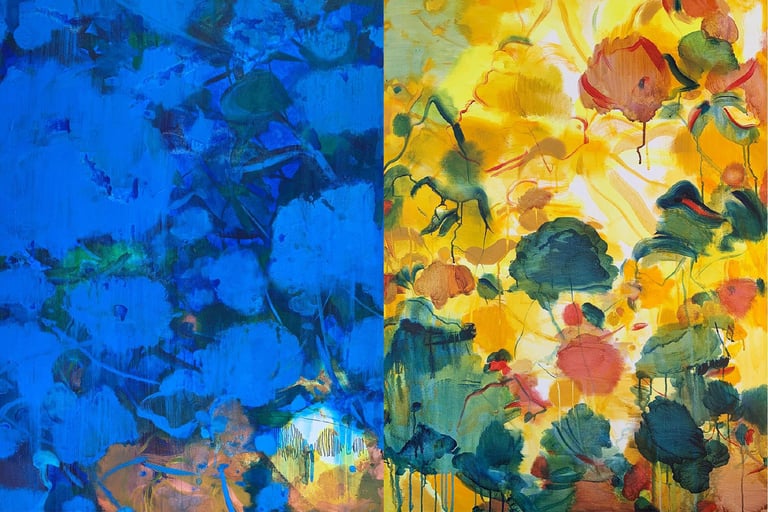
Siyuan Chen’s painting, Blessing - Light of the Narrow Gate (2023), exhibited at the Sarasota Art Center, is a side-by-side acrylic diptych abstract painting. The contrast illustrates a paradox: one may choose either a wider road leading to darkness or a narrower, less traveled road with lots of difficulties yet leading to success. Chen communicates this idea using a color palette and brushstrokes forming different lively objects depending on one’s viewing angle. This diptych prompts the viewer to make a final decision on which path to take.
Siyuan Chen’s paintings are known immensely for their captivating color palette; Blessing - Light of the Narrow Gate is no exception. Although each painting is so different from the other, they do echo and support each other to deliver the message of the narrow gate theory toward utmost fulfillment.
One obvious difference is the distinct dominant color palette in each painting: one dark and the other very bright. Blue is the dominant color in the painting on the left. There are blue splotches, blue splash marks, and blue sweeps of the brush. The sweeps are not as defined as impasto, most likely due to the use of acrylic paint instead of oil. In contrast, yellow is the dominant color in the painting on the right.
This contrast shows the sacredness of the narrow way. As one looks closer, each painting is not completely monochromatic. The one on the left adopts a split complementary color scheme. There is a variety of blues, some are paler or darker while others are mixed in with variations of green, creating greener blues or even blue greens. The green shades in cue also have a variety of values. This heavy analogous color scheme creates a depth and a moody feeling: eerie silence, quietness, and mystery. Yet, the bright orange screaming at the bottom of the page suddenly breaks through, and makes a transition to the next painting, which also shows the split complementary.
Unlike the gloomy painting of a wider entrance, the right one seems to have an abundance of life and joy regardless of the obstacles at the entrance. The yellow painting, with abstract life creatures: flowers, birds, mountains, and even possible human faces, is placed on the right with a divine symbolism as the right is usually shown to be the “good side” in religious art. In the Chinese culture, right is the dominant or superior side. There is also more variation in color (through reds, oranges, and yellows) that radiates, injecting energy throughout. The upfront variations of yellow illustrate the divine prosperities through the narrow gate.
The journey to the narrow gate also amplifies life through its implied life forms. Chen’s variety of brush strokes (little imitations of impasto, dry brushing, and splotches that seem to be mixed on the spot) have morphed into familiar forms such as flowers, birds, bushes, and even mountains. These mountains may form a narrow way to reach Heaven’s gate, symbolizing the difficulties and loneliness one needs to overcome on the journey to success.
Unlike the previous painting with the black background, although these mountains and bushes are also blue, they provide an uplifting feeling as they lie on top of the yellow. The multitude of these landmarks show perseverance and strength through the tough journey. The brown colors may symbolize seasons of dryness and wilderness during the ups and downs in life. The vivid bright reds and abstract flowers and birds (you can almost hear them sing!) show that it’s all worthwhile. The bright glow further indicates that God is with us every single step of the way onto glory.
The possible implied path for the right painting contrasts the left; the right generates a lost feeling as there is no direction and no definite, satisfying finishing line. This lack of finishing line shows that the wide path could lead to zero fulfillment. A warning sign to all is to stand firm to the narrow path since it alone leads to life even though following the crowd/world may be an easy start.
In conclusion, Blessing of the Narrow Gate is a diptych, with an intention to let viewers pry open the two paintings as doors to “the gate.” They may choose either the easy way leading to destruction/loss or the challenging way leading to life/joy. Through use of contrasting colors and implied objects, this painting challenges the viewers to make a conundrum choice.
Siyuan Chen, Blessing - Light of the Narrow Gate, 2023
Acrylic on canvas, side by side as a diptych 40 x 30 inches each
Sarasota Art Center Exhibition, “An Abstract View”, Sarasota, FL
High School Magazine Publications
We've All Been There
(Accepted in "In a Nutshell" - Longleaf School of the Arts Magazine, Spring 2021, Vol 5, p. 9)
We've all been there,
Where the future ain’t bright,
Where all you see is haze and fog,
Blinding your eyes to the point of despair.
But sometimes we need to see the fog
In order to see the clear.
When the future ain’t full of color,
Where all you see is grey and black,
Learn to push on and find a way,
Fill your eyes with determination and fight back.
Because sometimes we need to push through the fog
In order to see the clear.
When the future ain’t full,
Where all you see is emptiness and isolation,
Learn to find someone to support you,
Open your mouth to someone you trust and pour it out,
And listen to what they say.
Because we need a little help over the fog,
In order to see the clear.
We’ve been there also
When we see people living where it ain’t bright,
Where all they see is haze and fog,
Blinding their eyes with despair.
But we need to make a path
To those in haze.
When we see someone in a colorless world,
When we see someone living in black and grey,
Learn to shine light to show them the way,
Learn to use your light to help others see through the dull.
Because we need to shine on others,
In order for them to see colors.
When we see someone in the empty world,
When we see someone living in emptiness and isolation,
Learn to be their supporter,
Open your ears to hear their rants,
And open your mouth to give love.
Because we need to help others over the fog
In order for them to see the clear.
We’ve all been there,
Where the future ain’t bright,
Where all you see is haze and fog,
Blinding you to despair.
Learn to see through the fog,
And lead light to those in haze.
For we’ve all been there,
Where the future ain’t bright
And all you see is haze and fog...
Start a light and be a light!
Beulah Land
(Accepted in "In a Nutshell" in Longleaf School of the Arts Magazine, Spring 2022, Vol 6)
Years ago, down in memory lane,
A bubbling brook sang beside a hundred-year-old farmhouse,
A blue and white painted cement path to look like bricks
Lead to its entrance of tranquility and innocence,
Stars twinkle above the house, blessing it will their glow,
And Grandmother Lee Ann herself...
The sweet woman that treated me like her own granddaughter.
The house was small and cozy, packed with dogs
Who licked me with their wet tongues,
While the cats lazed about staring at me with their green eyes.
The guest room had exquisite artwork hung on the walls,
Marbled with color and detail,
With a bed covered in an antique, colorful patchwork quilt,
The sun’s golden rays, glowing through the crystal glass
And the moon lighting the room bright as a pearl.
The backyard was opened by a fence,
Where the bubbling brook sang peaceful melodies,
And flowers budded their delicate baby-soft petals
To welcome your presence.
A swing with an old rope hooked itself around an old tree.
There, I flew with no fear of the world
Before jumping off to feel the cool brook’s waters at my fingertips.
In the evening, the old stove warmed the ancient farmhouse
And filled with delicious smells that squealed at your nose,
The kale and bacon dish was my favorite,
The contrast of porky juices melding with greenness,
Raspberry water too, unmistakable tinted pink,
With clusters of rubies slid from a crinkled hand to a jug of water,
Tasting of cupid’s arrows,
Finally, golden dices of peaches in creamy scoops of pale yellow,
Churned with ice and everything nice.
And when all the farm goes quiet,
The mattress is soft, seducing you into its embrace,
The pillows kissing your cheek goodnight,
You fall asleep like a newborn,
With your worries emptied out for now,
You will remember this hundred-year farmhouse in Boone, Beulah Land!